



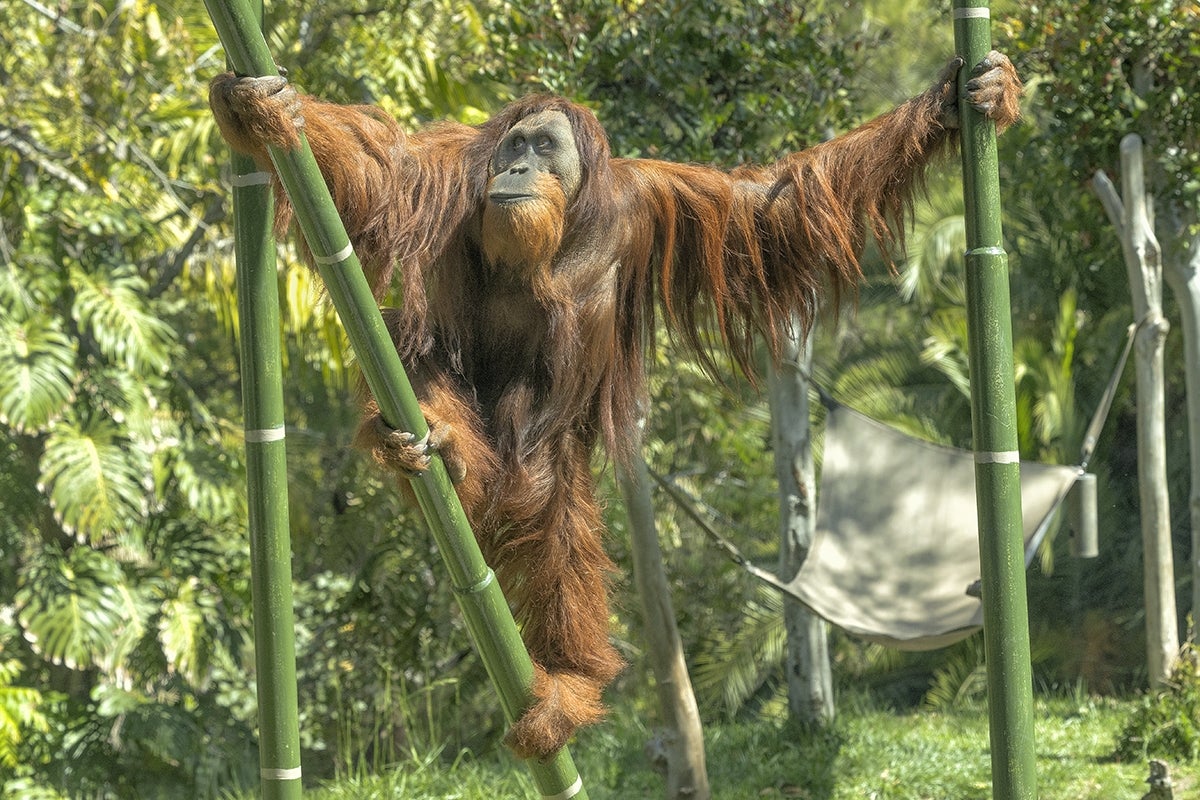

Experiencing a group of Sumatran orangutans at the San Diego Zoo is witnessing a world in constant motion. Little Kaja excitedly scrambles up a rope leading onto a towering climbing structure while his mother, Indah, looks on. Another of Indah’s offspring, Aisha, watches contentedly from a sunny spot on a soft patch of grass. Karen uses a stick to investigate the many holes in a faux termite mound, then moves over to a rock formation and drinks from a pool of water. Observing all of this is the group’s newest member, Labu. His arrival marks a new beginning, both in his personal journey as a maturing male orangutan and for the group that welcomed him.
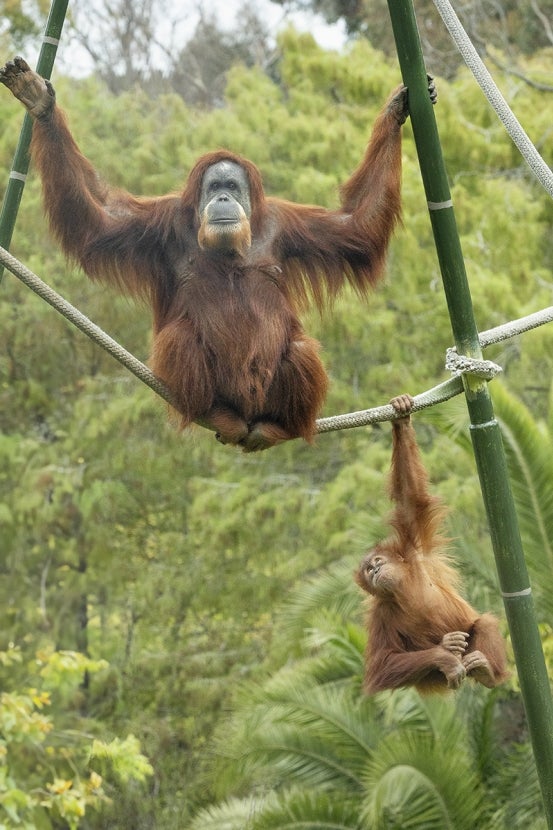
Indah's (top) first instinct was to keep newcomer Labu away from young Kaja (bottom).
New Perception
Watching this vibrant community, it wouldn’t be obvious that orangutans are considered the only semi-solitary apes. But for a long time, this was the case. Orangutans were observed over large areas in their native forest habitats on the islands of Sumatra and Borneo, and while they interacted with other orangutans while moving throughout the trees, they did not form tight social groups.
However, recent studies indicate this isolation was simply a necessity for survival. Because orangutans mostly eat ripe fruits they find scattered across the forest floor, they have to spread out to find sufficient resources and ensure all have enough to eat. When food is plentiful, they are more social. Unfortunately, their native habitat is threatened by deforestation, mainly driven by the clearing of land for unsustainable palm oil plantations. This decreases the support available for orangutans and makes it difficult for them to come together in groups.
Orangutans at the Zoo experience abundant resources throughout their expansive and multidimensional ecosystem. Just as they would in native habitats, they choose how they want to engage with the space—and with each other. And when their survival is not at risk, it turns out orangutans aren’t so solitary after all. They form intimate bonds based on respect, communication, and their own special type of family.
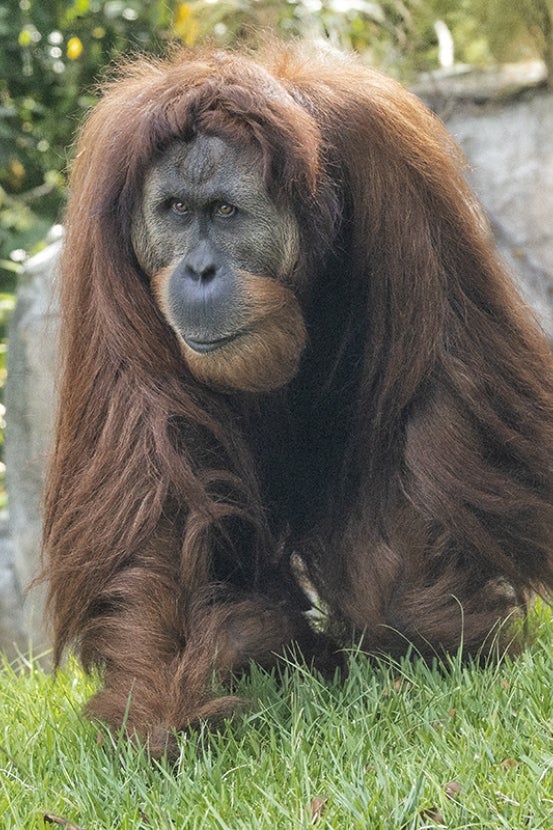
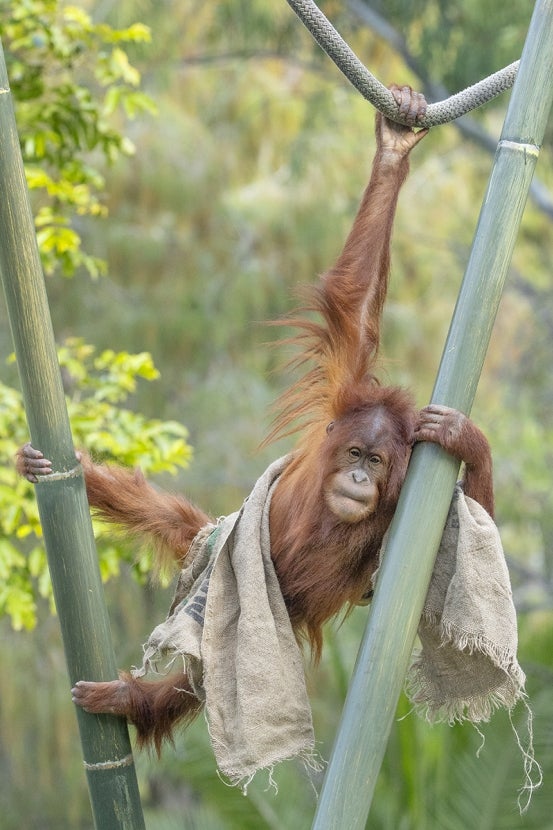
Labu (left) sensed Aisha’s (right) shyness and allowed her to approach him. Now they are becoming friends.
New Connections
When 14-year-old Labu was welcomed into the Zoo group, he was a bit hesitant. As a young adult male, he hadn’t spent time outside of his family group. This was his opportunity to venture out on his own and start again as a self-sufficient orangutan.
Naturally, Labu approached the group with caution and deference. An older and more social female, Karen, was the first to welcome him. Karen was friendly with her new companion, and Labu quickly connected with her, looking to her for guidance during his first few weeks. Because orangutans generally don’t form large social groups, they don’t default to hierarchical or gender-based relationships; they choose who they want to interact with, and in what way. “While Labu is the largest and strongest member of the group, he’s been closely following Karen’s lead on how to get the most from daily orangutan life in his new home,” says Heather Myers, wildlife care supervisor, primates. Karen showed Labu their complex habitat and taught him how to engage with the many diverse resources they could discover there. Labu’s bond with Karen gave him confidence and made him comfortable enough to not force interactions with more cautious orangutans, like Aisha. Instead, their bond could evolve slowly and organically.
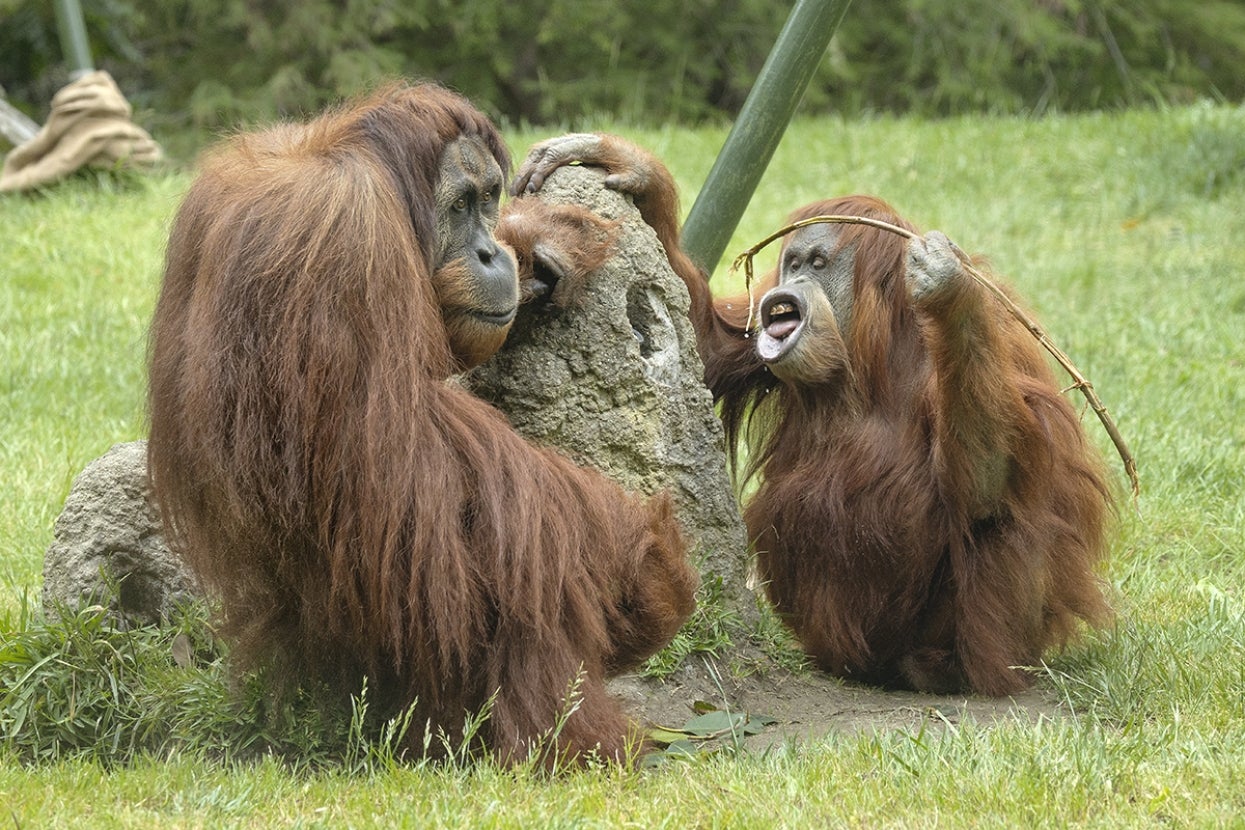
Confident and friendly Karen (right) was the first to welcome Labu (left) to the group.
Aisha was very interested in Labu when he first arrived, but wasn’t sure how to approach him. The two are in similar life stages, but Aisha did not have much experience with males, especially ones close to her own age. She wasn’t fond of Labu approaching her first, and she let him know. Orangutans are incredible communicators and set firm boundaries with each other regarding different aspects of group life. According to Tanya Howard, senior wildlife care specialist, primates, “They are so subtle they could be having full conversations and we wouldn’t know it.” Labu showed understanding for his more reserved companion and allowed her to approach him from that point on. This gesture built trust and strengthened their connection. Now Aisha chooses to spend more time near Labu, and they even share a hammock occasionally. With this new relationship, Aisha is growing into a more self-confident young adult.
Indah, the oldest, was a bit more wary of the newcomer. Her son, three-year-old Kaja, was the youngest in the group, and her top priority was keeping him safe. Orangutans are dependent on their mothers for about eight years, much longer than most other species, and the bond between mother and young is very strong. When Labu first arrived, the normally rambunctious Kaja paid attention to his mother’s cues and stayed close to her. But his curiosity soon got the best of him, and he started watching Labu interact with the females. “Kaja is going to mature a lot with another male present,” says Tanya. Even from a distance, Kaja can learn appropriate ways adults interact with each other, how to set boundaries, and how to properly engage with females—opportunities he wouldn’t have without the abundant resources available at the Zoo, as male orangutans do not interact with little ones in less plentiful environments. Having a role model like Labu makes it much more likely that Kaja will grow into an easy-going and respectful orangutan himself. “[Labu is] a dream male,” adds Tanya. “Textbook, this is how you want a male to behave. It’s been a phenomenal experience.”
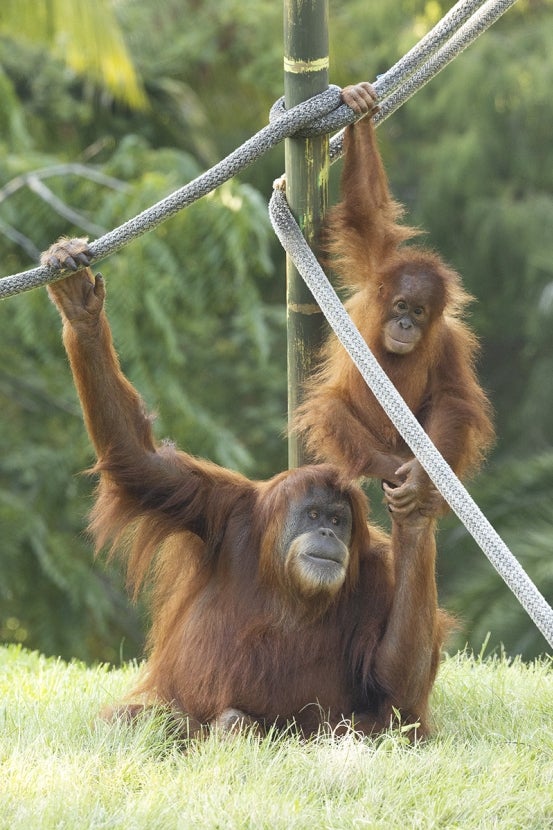
Seeing a calm role model like Labu will help spirited Kaja (top, with Karen) as he grows up.
New Beginnings
As Labu continues developing relationships, his confidence grows. He has gone from a shy young male to a lively and charismatic member of the group. His journey to find his place is one anyone can relate to as they navigate the world seeking a sense of belonging. This is one of the many reasons Heather has heard guests say the orangutan habitat is the first place they come when they visit the San Diego Zoo. “People really feel like they can make a connection to them,” she says, just as the orangutans are making connections with each other.